

“You should go to Berlin or Cannes—they’re really fun and good places to meet people,” producers would say to me. But I was always like: What do you mean? Why would I go to a festival if I don’t have a film there? What would I even do? Can my fragile filmmaker ego handle going to a party I wasn’t invited to?
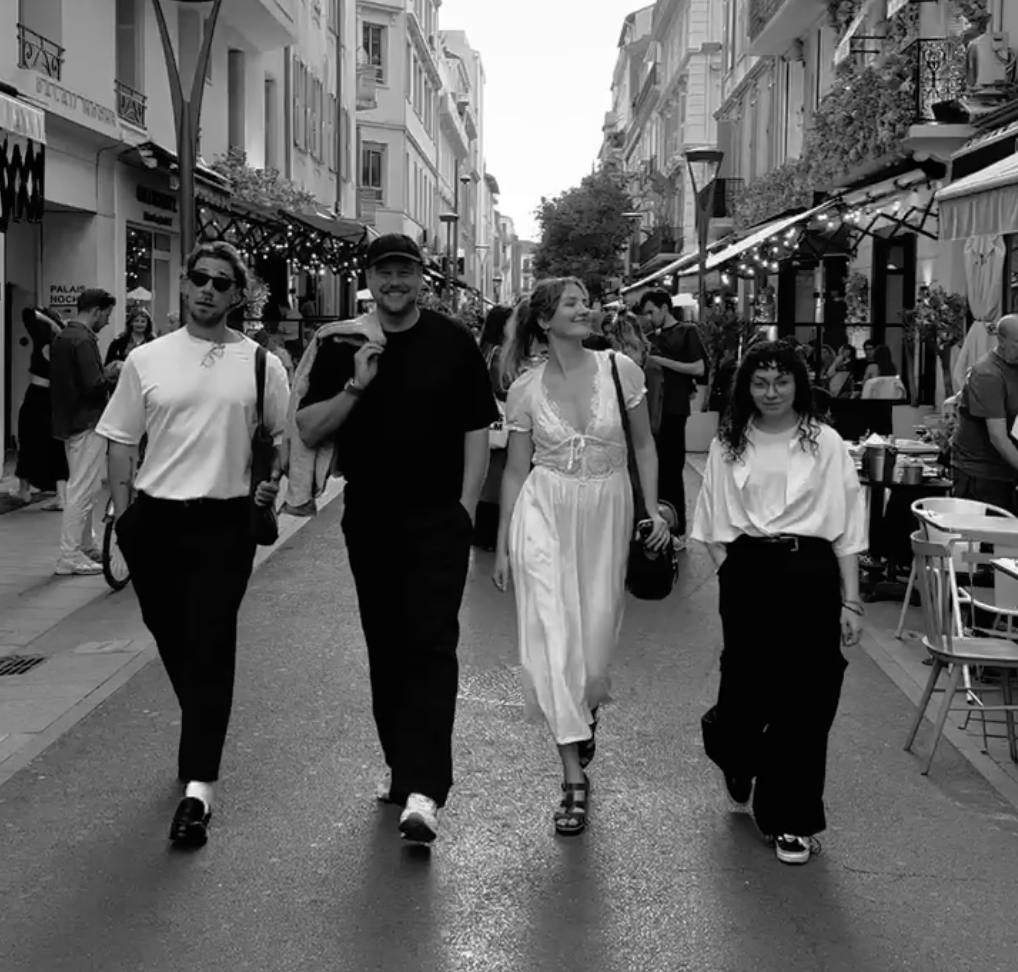
But in January I got some cool news: myself and three other up-and-coming filmmakers were chosen to attend the Cannes Film Festival as part of a Dutch talent program. The goal was to teach us about the secret world of the festival circuit and to have us meet every single person present, or so it seemed. We were sent lists and lists of attending producers from all over the world to research and set up meetings with. We were asked to prepare verbal pitches, pitch decks, one-pagers, printouts, and last but not least suitable sartorial choices for Cannes famously formal dress code. By the time we were on a plane most of us were pretty nervous and at least a little intimidated—if not by the dress code and stature of the festival, then at least by our packed schedules.
But Cannes turned out to be a wonderful experience—and most of all, extremely educational. So in case you too are a filmmaker that hasn’t been to a big festival yet, and are wondering whether you should go, here are ten things I learned from attending the Cannes Film Festival as a new/upcoming/early-career/whatever filmmaker:
1. It’s an industry event – but like, really
Yes, there’s glitter and glamour and gowns and red carpets. But when it comes down to it, Cannes is an industry event – like the ones they may have at your nearest Convention Center for heating and air conditioning, just with more couture. Cannes is literally party in the front, business in the back, as the front of the Palais has the premieres and the back has the convention, the Marché du film. And a marché (market) it is.
Any romantic notions about filmmaking will be left at the entrance here. This is not where people speak of stories and cinema and symbolism, but of minimum guarantees, gap financing and tax rebates. There are endless – and I do mean endless – booths, all featuring posters with the most bizarre titles, that make you feel like movies are made and sold by the pound and neither quality nor artistry are of much concern.
2. Everyone is there
This may be self-evident but people don’t just go to Cannes to see films or attend premieres. A lot of people go to Cannes and never even see a film. People attend each year simply because everyone else does as well. From directors from Denmark to B-horror producers from Brazil to Angelina Jolie, film folk from all over the world rendez-vous in Cannes. So it’s the perfect place to set meetings with people you otherwise wouldn’t meet or only know through email, and catch up with the ones you do.
3. Come prepared
Cannes is meant for meetings. That’s why it’s good to come prepared. Look up who will be attending and find out if they have 15 minutes to spare for you, because fifteen minutes is apparently how long typical Cannes meetings run. For each of your projects, have a short verbal pitch ready, a more elaborate digital one and maybe a little postcard with a QR code to the screener or pitch. I was very opposed to the postcard thing because A: trees and B: it just felt so cringe to me. But in the end I’m glad I had them as I was asked for them on a few occasions. And my mom likes the spares. Also, it helps to set some goals, because Cannes can be super overwhelming – but more on that later.
4. Take analogue notes
You will meet a ton of people and you might forget or mix up who you spoke to, what they said, and what the follow-up was supposed to be. It’s therefore not a bad idea to keep notes on your meetings. Just to illustrate: I met – as in had a conversation that lasted beyond 10 minutes – with around 53 people in five days. So unless your memory is AI-level, get a notebook. Science has proven that actually writing things down by hand helps you remember better. Plus: typing on your phone makes you seem uninterested. So go old-school with paper and pen.
5. It’s humbling
Unless you’re wealthy, well-connected or wonderful at talking your way into parties, you’ll most likely not be part of the glamour Cannes is known for. Tickets to premieres are hard to come by and people wait in line for hours – nay, days – to get them. Many people hang out near the Palais around premiere time in a tux or dress, hoping to find a way in with the red carpet royalty.
With all this glamour and gathering of the greats, Cannes can make you feel quite insignificant. Even after having lived in Los Angeles right around the corner of where the Oscars were being held, I found Cannes’ aire of exclusivity with its yacht-filled coast, Chopard sponsored dinners and secret after-parties to be on another level. Perhaps because Hollywood is tacky and touristy during the day whereas the Cote d’Azur is always, well, French. When you’re just starting out, all this can be quite humbling. But a bit of humility is healthy. Especially for directors (myself included!)
6. It’s overwhelming
The sheer volume of production, people and deal-making at the palais as well as every patio in town can be overwhelming. Where should you go? Who should you talk to? How can you conquer a little corner for yourself in this seemingly impenetrable industry? Our filmmaker app group wasn’t called Everything Everywhere All at Cannes for nothing.There really are a million things going on at any given second in any given place. It can feel like you need to be everywhere at once, all hours of the day – and night – and even then you are still missing out.
7. But it doesn’t matter
Personally, I quickly found peace in all this for the simple reason that I physically could not be everything, everywhere, all at once. I would normally try – believe me, my FOMO is psychotic – but there are too many places, people and parties. The same goes for film festivals on the whole. You can try to network with festival directors and analyze and strategize but so many films are submitted to festivals each year that there’s a huge degree of luck involved in getting selected (more on that later).
But that’s okay—that’s where the peace comes in. Because not only are none of those things your job (unless you’re also a producer), they’re also wildly beyond your control. The only thing you can do as a filmmaker is focus on the work, and try to make the best film you can. Everything else is, quite frankly, a crapshoot. So replace your frenzy and fear with some French laissez-faire.
8. Festival selection is not just about taste &quality
Of course art is subjective and any filmmaker knows that beyond a certain base level of technical skill, a lot of the time what’s considered a good film is subject to taste, trends, and the time we live in. Though I will say lot of festivals seem to love poverty porn or equate darkness with depth. Anyway, while at Cannes we got to speak to many festival directors, from Sundance to Venice, and it taught me quite a bit about the festival circuit. Most of all that films are not just selected by personal taste, but also by country and theme. With space for so few films, a lot festivals don’t want to program two (feature) films with a very similar theme – no matter how good they both are. In that case they may look at country representation. As festival selections can make or break filmmaker careers, you can imagine the impact this has. It hits home once more a lot is out of your control, so just focus on the work.
9. Don’t stress about the dress (code)
My biggest stress factor before flying was what the hell to pack in my single hand luggage-sized suitcase. One of my fellow directors even had his girlfriend make a moodboard for him before they went on a dedicated shopping spree. So let me break down the daunting dress code for you: For the premieres in the big theater, the Lumière, there’s an evening wear dress code that consists of tuxedos, floor-length gowns or “a little black dress, a cocktail dress, a dark-colored pantsuit, a dressy top with black pants; elegant shoes and sandals with or without a heel (no sneakers)” or “a black or navy-blue suit with bow-tie or dark-colored tie.” Gender isn’t specified so technically one can be creative but in reality it means no tan or colored suits for men. The chance you’ll be at one of these premieres is small though, so don’t spend too much time on your sartorial selection.
The premieres at the smaller theater, the Debussy, are a lot less strict. They require tenue correcte, which apparently included the linen sandals my producer wore and my bohemian summer dress. I think it just means: don’t show up in flip-flops, jeans or shorts. At the market they don’t really enforce a dress code, from what I could tell, but most people dress classy and business casual. It’s a work event, after all!
Bonus: ‘Dad’ is a universal language
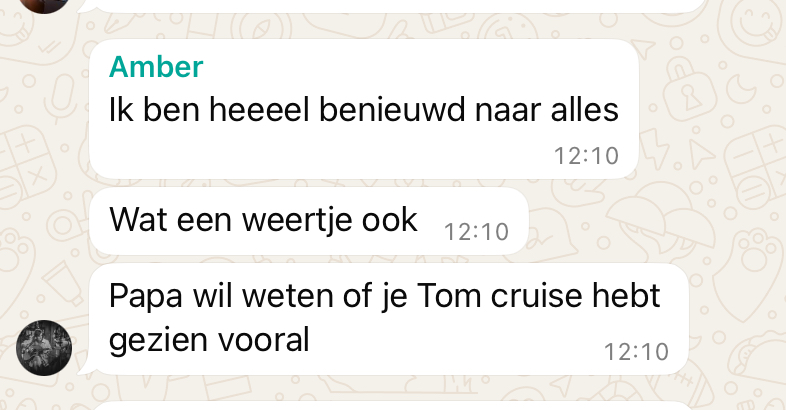
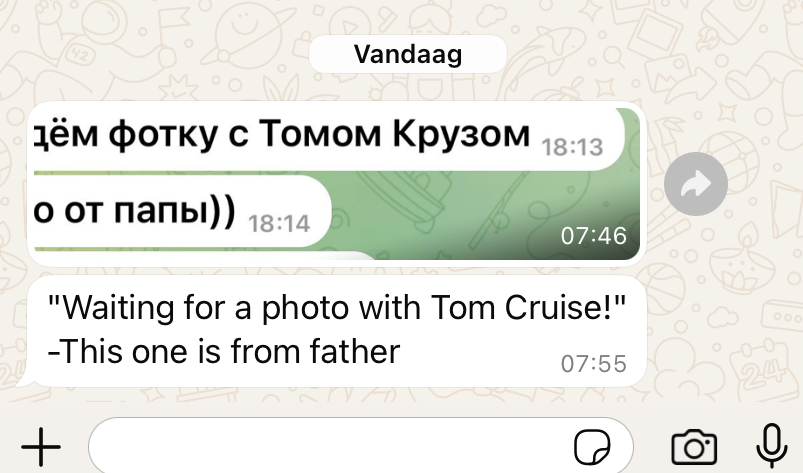
If you’re from a normal family, here meaning without ties to the art world, and have the privilege of still having your father around, he will react in only one way to your Cannes adventure: he will ask – usually not directly but through your mom or siblings – if you’ve seen Tom Cruise yet. Both me and my Ukrainian roommate’s dad passed on such a message on day two our Cannes experience, of which I’d like to present exhibit A & B.
10. It’s super fun
If you’re able to let go of impossible goals and the idea that you need to be everywhere at once, Cannes is a super fun place to meet fellow filmmakers and just be for a week. You can see films. You can eat croissants. You can watch people parade through town in tuxes and gowns. There are free drinks everywhere, the sun is usually shining and there’s an infectious energy that buzzes through the town.
Prepare, partake and never forget: You are Cannes-nough.
Just as you are.

Love this! Great write-up